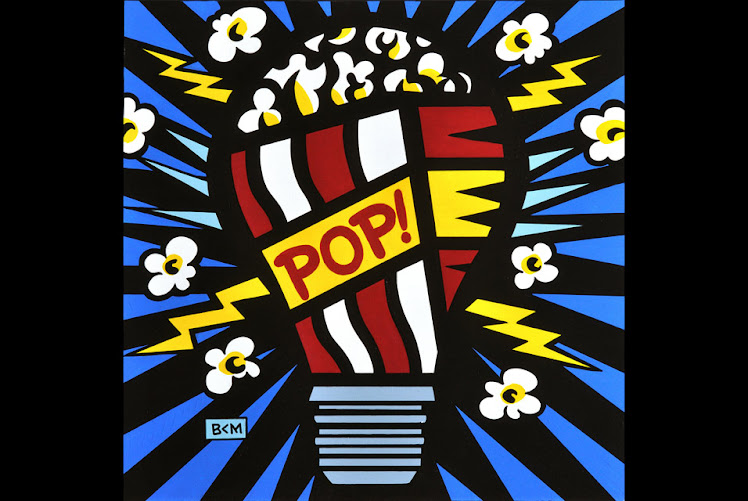
Pop Art is the new black this Spring

Pavli Medvedova

 
 Every magazine has its own way of introducing the trends we should keep our fashionable focus on. I usually can’t really get my head around it and get pretty confused. So I try to stick to one source that gets my inspiration going and then let the magic happen.

 According to Style.com there are 5 main Spring Trends for 2014 we should keep an eye on.

 The one that gets me excited is all about bold art. Spring is the time of the year, when we stop wearing comfortable pieces in black, grey or brown and start thinking about colors, designs, skirts and sunglasses to get us through those warm sunny days.

 We definitely have plenty of artistic designs to look forward to. Designers wanted to be like Picasso and introduced collections with a fine-art spin for the coming season. There was Karl Lagerfeld and his Pantone-streaked dresses at Chanel, Prada introduces designs with images from political street muralists, and Louis Vuitton opened his show with Edie Campbell covered in graffiti.

 I personally can’t wait to get some of the artistic pieces especially knee-length skirts and dresses.

  There is a saying that a trend is not a trend until it’s worn on the street. Will you be wearing this art-inspired trend?

‘Pop Art Prints,’ at the Smithsonian American Art Museum, proves that Pop artists weren’t shallow

A Pop art collage of a giant Donald Duck head, an old family photo and lots of power tools — funny, odd, maybe a wry nod to consumerism, but hardly a Rembrandt, right?

“Pop art is much more layered and complex than people think,” says Joann Moser, curator of “Pop Art Prints” at the Smithsonian American Art Museum. “It serves as the mirror that exaggerates … reflecting the culture we live in back to us in the different way.”

Pop art works are indeed deeper and darker than their bold, flat appearances suggest. The artists, who were at their busiest in the 1960s, were inspired not only by advertising and popular culture, but also by the politically charged events of the era and the media that covered them.


Many Pop artists worked with texts and images taken straight out of newspapers and magazines. Jim Dine, Robert Rauschenberg and James Rosenquist regularly used media clips in their works. Andy Warhol produced a series of monochromatic prints illustrating media coverage of death and disaster. A few of these — screen printed photos of Jackie Kennedy at President Kennedy’s funeral, and police dogs attacking a civil rights protester — are in the exhibition.

Not that the artists themselves were any less bewildered by current events than fans and critics of their works: “Pop artists were commenting on consumer society, while attempting to understand it themselves,” Moser says.

Smithsonian American Art Museum, Eighth and F streets NW; through Aug. 31, free; 202-633-7970. (Gallery Place)


Robert Indiana, "Love," 1967: Robert Indiana originally designed “Love” for a Christmas card in 1965; later, he made screen prints (shown below), sculptures and paintings of the image. Consumer culture spawned the work, which led to actual consumer products: Today, “Love” appears on T-shirts and knickknacks worldwide. “There was always a lot of back and forth between Pop art and advertising,” Moser says. (Morgan Art Foundation/Artists Rights Society)

Robert Indiana, "Love," 1967: Robert Indiana originally designed “Love” for a Christmas card in 1965; later, he made screen prints (shown below), sculptures and paintings of the image. Consumer culture spawned the work, which led to actual consumer products: Today, “Love” appears on T-shirts and knickknacks worldwide. “There was always a lot of back and forth between Pop art and advertising,” Moser says. (Morgan Art Foundation/Artists Rights Society)