Showing posts with label Bloglapedia. Show all posts

Right at Home: Pop art packs decor punch


BY KIM COOK

Mid-century modern style is now firmly planted in the home décor landscape. And one of its elements, pop art, is cultivating a 21st century following. 
Eye-catching, graphic, often tongue-in-cheek or sassily whimsical, pop art décor plays well off the vintage vibe and yet also makes contemporary furnishings, well, pop.
In the 1950s, Abstract Expressionism dominated the art world, with Willem de Kooning, Mark Rothko and Jackson Pollock among its superstars. The canvas served as an arena for aggressive applications of paint. Conceptual, nonfigurative art found a strong following in the art world, if not always with average Americans, at least at first.
In the effervescent, culture-obsessed 1960s, artists like Andy Warhol, Jasper Johns, Roy Lichtenstein and David Hockney created collages, mixed media art and lithographs that depicted the talismans of popular culture. They took inspiration from consumer culture, from soap boxes to soup cans, flags to the funny papers, Marilyn Monroe to Mao. While some critics derided it as jokey, low-brow or too focused on materialism, the approachable imagery connected easily with mainstream America. It was hip, fun and relatable.
“I consider pop art a classic,” says Jennifer DeLonge, an interior and product designer in Carlsbad, California. “It was such an important time in design and it continues to withstand so many fleeting trends. As a designer, I'm always drawn to pop first because I appreciate graphic lines and very obvious color.”
DeLonge has launched a social marketplace app called Reissued that brings lovers of vintage, one-of-a-kind and hard-to-find items together to buy and sell. A bright yellow 1960s Coke bottle crate was recently up for grabs.
Fab.com's pop art décor includes Quinze + Milan's giant Brillo box pouf. Also of note: Karlsson's minimalist wall clock made of two oversize red hands; Finnish designer Jonna Saarinen's abstract, printed birch tray in vivid tangerine and red; and lithographs in the Masters of Pop Art collection that includes Warhol's portrait of Muhammad Ali, Keith Haring's “Untitled” series, and Roy Lichtenstein's “Blonde Waiting.”
Biaugust's whimsical little black upholstered chairs shaped like ponies, lambs and buffalo are available at Mollaspace. Here too is a vivid bubble-gum-pink and Slushie-blue map of the world, as well as acrylic coasters printed with blank cartoon-speech bubbles that can be written on with a reusable pen, and a series of canvas storage bins printed with old-school boom boxes, radios and TV sets. 
A few pop art accessories in a room make a statement for a modest price. Creative Motion's cylindrical table lamp printed with comic-strip imagery is under $50. A collection of kicky, '70s-style graphic print pillows from notNeutral pack pop punch. 
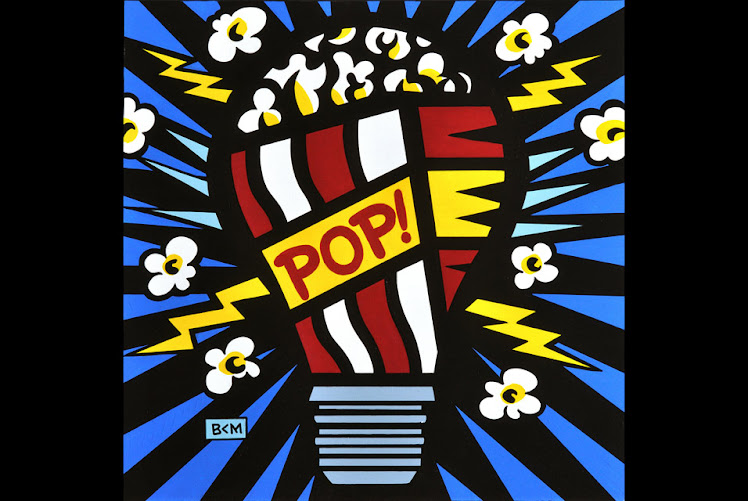
Canvases and throw pillows from the Los Angeles art decor studio Maxwell Dickson feature some arresting, edgy designs, including a photorealistic image of a tableful of empty liquor bottles, a typographic traffic jam of color-blocked letters, and the word “POP” exploding like a cartoon graphic. 
The Museum of Modern Art's store has lots of pop art items from which to choose: Damien Hirst's white wall clock with colorful polka dots would be terrific in a child's room. Verner Panton's black and white Optik pillow features a dizzying kaleidoscope of circles and stripes that's as much “op” as “pop.” There's also a wide range of prints and postcards that you can frame yourself. 
Check Spoonflower.com for fabric yardage and wallpaper with pop art prints from new designers. There are psychedelic-inspired patterns, and even a chicken print that riffs off of the now- famous screen-printing technique that Warhol used for portraits.


POP! goes the Figge


A piece from Andy Warhol's "Ladies and Gentlemen," foreground, is on display in the exhibit "American POP!" at the Figge Art Museum in Davenport.
IF YOU GO
What: "American POP!"
When: Today through Sept. 8; hours are 10 a.m. to 5 p.m. Mondays through Saturdays and noon to 5 p.m. Sundays; there is free admission for nonmembers from 5 to 8 p.m. Thursdays
Where: Figge Art Museum, 225 W. 2nd St., Davenport
How much: $7 for adults, $6 for senior citizens (60 years and older) and students with an ID, $4 for those 3-12 years old
Information: 563-326-7804 or FiggeArtMuseum.org
Among the various colorful pieces in the gallery at the Figge Art Museum's new pop art exhibit are three large blueprints.
Most of us see blueprints as more practical than artistic, but these bear a second look when you see the locations depicted:
• Wayne Manor, the home of Bruce Wayne and Dick Grayson, the alter egos, respectively, of Batman and Robin.
• The home of Mike and Carol Brady of Los Angeles, which housed their bunch of kids and a maid. (For the record, it has three bathrooms.)
• A plat of the "city" of Mayberry, N.C., where Sheriff Andy Taylor kept the peace.
Is it art? It's seen as that in "American POP!" opening this weekend at the Figge in downtown Davenport.
Curated by the CU Art Museum at the University of Colorado in Boulder, "American POP!" has its Andy Warhol representation (a pair of 1974 silkscreens from his "Ladies and Gentlemen" series), a pair of Roy Lichtensteins (including one of a pointing finger titled "Untitled (Finger Pointing)" and some works by Robert Rauschenberg, with three rather one in various styles.
But there's also a re-creation of a Brillo pad label; works by artist John Baeder, who has three portraits of classic old diners, and linocut artist Wayne Theibaud's delicious "Boston Cremes," which shows 10 desserts ready for the taking.
"Some of the art exhibited here is not traditionally seen as pop art," Figge associate curator Rima Girnius said.
The works, she added, are reactions to both the modern expressionist era and the consumer-driven culture that drove America after World War II.
"Pop artists really abandoned expressionist and embraced a more external environment," she said. "They tried to reverse the elitism of abstract expressionism."
The end of the war brought a continuous set of changes, she said.
"Life was completely transformed by the presence of ovens and washing machines and supermarkets that provided massive amounts of cheaply packaged foods," she said.
"Pop art was kind of a response to this consumer-driven society because they appropriated sort of simple, everyday materials and imagery that was taken from the mass media world," she added.
That includes seeing the homes of the Bradys, Batman and Barney Fife.
"The homes that we see on television seem nearer and dearer to us than the homes of our neighbors," Girnius said. "We know more about these fictional families than our neighbors."
"American POP!" she added, "sort of reflects a media-obsessed culture."

Lyman Allyn Art Museum opens Pop Art exhibition


Lyman Allyn Art Museum announces the exhibition, "Pop Goes the Easel: Pop Art and its Progeny", opening March 3 and on view through Aug. 10. The exhibition is guest curated by Barbara Zabel, Ph.D. professor emeritus at Connecticut College.
By exploring traditional modes of easel painting, Pop artists of the 1960s radically expanded the possibilities of how art is made and how it is viewed; thus they opened up multiple pathways for artists coming to maturity in later decades of the twentieth century.
Pop Goes the Easel includes works by male pop stars like Andy Warhol and Roy Lichtenstein, as well as works by women artists like Idelle Weber and Marjorie Strider, who were marginalized in the male-dominated decade of the 60s. The exhibition also explores the myriad avenues opened up by Pop in the more politically engaged decades that followed.

Exhibition programs and events:
Gallery Talk
March 6: Pop Goes the Easel! with Barbara Zabel and Devon Elovitz, at 4 p.m. Admission for members is $5, for non-members it is$10. To make reservations, call (860) 443-2545, Ext. 129.
Artist Talk
March 28: Let ‘er Buck, artist Nancy Davidson; Reception at 5 p.m., presentation at 6 p.m. Admission for members is $5, for non-members it is $10. Call (860) 443-2545, Ext. 129 to make reservations.
Lecture
April 4: "Pop on the Dark Side: Performance Art and Pop Art" by Karen Gonzalez Rice, Connecticut College Art History Professor; Reception at 5 p.m., lecture at 6 p.m. Admission for members is $5, for non-members it is $10. For reservations, call (860) 443-2545, Ext. 129.
Film Screening
April 11: "The Films of Andy Warhol," with Ross Morin, Connecticut College Film Studies Professor, at 4:30 p.m. Admission for members is $5, for non-members it is $10. Call (860) 443-2545, Ext. 129 to make reservations.
Lecture
May 16: "Lichtenstein Revisited" with Janis Hendrickson Mink, Reception at 5 p.m., lecture at 6 p.m. Admission is $5 for members, $10 for non-members. To make reservations, call (860) 443-2545, Ext. 129.
Free First Saturdays
Join us each month for a fun family day with free admission from 10 a.m. to noon.
Art activities and snacks for ages 5 – 12 are available on First Saturdays from 1 to 3 p.m., free with Museum admission.

Check www.lymanallyn.org for updates and additional programming. Tours of the exhibition will be available for groups. Lyman Allyn Art Museum is located at 625 Williams Street in New London.


Pop goes the art classes at the Campbell River gallery


Are you ready to get Poptastic? Join instructor Shannon McKirgan for a fun and educational kids’ class all about Pop Art at the Campbell River Art Gallery in May.
The class, for children aged seven to 12, takes place over three sessions, Wednesdays, May 8, 15 and 22, from 3 p.m. to 5 p.m. Kids will be inspired by Pop Art geniuses like Andy Warhol, Wayne Thiebaud, David Hockney and Claes Oldenburg, as they create a range of pop art pieces, including photo collage, portraits and soft sculpture. Pop art saw imagery from popular culture infilltrate fine art and it was pop-a-rific!
Instructor Shannon McKirgan is a painter and recent Emily Carr University graduate. Her work has been exhibited locally - most recently at the CR Art Gallery’s 31st Annual Members’ Exhibition, where she won an Award of Excellence, and the Muir Gallery in Courtenay. She has an upcoming solo show at the George Sawchuk Gallery.
The cost for Pop Art Pandemonium is $43 for CR Art Gallery members and $53 for non-members. All supplies are included. Winter/Spring Children’s Classes are sponsored by the Friends of CR Art Gallery.
Stop by the Campbell River Art Gallery Tuesday to Saturday from 12 p.m. to 5 p.m., call 250-287-2261, or email programs@crartgallery.ca to find out more about this great kids’ class.

Barneys New York Launches Roy Lichtenstein Limited Edition Collection In Collaboration With Art Production Fund


NEW YORK, May 2, 2013 /PRNewswire via COMTEX/ -- Barneys New York, the luxury specialty retailer, has partnered with the estate of Roy Lichtenstein and Art Production Fund to launch a limited-edition collection of home goods, available exclusively this summer at Barneys New York.  
The summer-themed collection includes trays, placemats, china dishes, glasses, paper plates, paper cups, pillows, flying discs, pool floats, water bottles, and beach accessories, including bags, towels, and beach balls covered in Lichtenstein's iconic Pop Art images of the '60s, '70s, and beyond. Lichtenstein original artwork utilized for this special collaboration includes Ice Cream Soda (1962), Drawing for Kiss IV (1963), Baked Potato (1962), Bananas and Grapefruit I (1972), and much more. 
"Barneys New York is thrilled to partner with the estate of Roy Lichtenstein and Art Production Fund," said Mark Lee, Chief Executive Officer, Barneys New York. "This collaboration has been in the works for some time. It's very exciting for us to mesh Barneys' appreciation of art with our desire to bring exclusive and limited-edition product to our customers, including our Chelsea Passage customers." 
25% of all sales from the collection will benefit Art Production Fund, a non-profit founded by Yvonne Force Villareal and Doreen Remen and directed by Casey Fremont Crowe which supports public art projects. The collection will retail between $28 and $295 and will be available at the Barneys New York Madison Avenue flagship, as well as Beverly Hills, Chicago, Miami and Barneys.com. 
"We are honored to be a part of this collaboration that provides the public with greater access to Lichtenstein's iconic and rarer works," said Art Production Co-Founders Yvonne Force Villareal and Doreen Remen. "The playful collection pays homage to the artist's longstanding interest in designing his own functional objects and in American consumerism in general." 
In addition to the collection, Barneys New York will dedicate its famed windows to Roy Lichtenstein with an installation conceived by Barneys Creative Director Dennis Freedman. The windows will be unveiled and the collection will be available for purchase in late April. 
About Roy LichtensteinRoy Lichtenstein (born in New York City, 1923) was one of the leading figures of the Pop Art movement. Depicting American pop culture and mass media with a sense of irony, Lichtenstein's distinct style has made him an icon of the 20th century. Lichtenstein found inspiration in popular advertising and the comic book aesthetic, and his artwork is recognized globally today. During the 1960s, Lichtenstein exhibited at the Leo Castelli Gallery in New York alongside Jasper Johns, James Rosenquist, and Andy Warhol. Lichtenstein continued creating works until his death in 1997. His artwork has been celebrated in numerous retrospectives worldwide. 
About Art Production FundArt Production Fund (APF) is a 501(c)3 non-profit organization dedicated to commissioning and producing ambitious public art projects, reaching new audiences and expanding awareness through contemporary art. Recent projects include: SHOW, Vanessa Beecroft, Solomon R. Guggenheim Museum, 1998; PLAN B, Rudolf Stingel summer 2004, Grand Central's Vanderbilt Hall and The Walker Art Center; Prada Marfa, Elmgreen & Dragset, Valentine, TX, 2005, permanent; Greeting Card, Aaron Young, Park Avenue Armory, 2007; Electric Fountain, Noble & Webster, Rockefeller Plaza, 2008. The Ghosts, Sue de Beer, Park Avenue Armory, New York City, 2011; After Hours: Murals on The Bowery, New York City, 2011; David Brooks, Desert Rooftops, NYC, 2012; Josephine Meckseper, Manhattan Oil Project, NYC, 2012; Kiki Smith, Chorus, NYC, 2012; Yoko Ono, Imagine Peace Times Square, NYC 2012; Yvette Mattern, Global Rainbow After The Storm, NYC 2012; Ryan McGinley, Taxi TV, NYC, 2013. Co-Founders: Yvonne Force Villareal and Doreen Remen; Director: Casey Fremont Crowe. 

'THE POP OBJECT' AT ACQUAVELLA


In 17th-century France the still life was considered the lowliest of genres, art historian John Wilmerding writes in the lushly illustrated catalog for this illuminating exhibition. Artists like Cézanne and Matisse brought the still life into the fold of Modernism, but one might say it had its apotheosis in Pop, a movement that excelled at exalting the banal.
The treasure-rich show, which its curator, Mr. Wilmerding, has packed with loans from numerous major museums and collections (including a funky vacuum-and-fluorescent-light piece from 1980 by Jeff Koons, courtesy of the Museum of Contemporary Art, Los Angeles director Jeffrey Deitch), is divided into four themes—food, flowers, housewares and, intriguingly, body parts.
The show reveals the widely divergent tones of Pop’s practitioners through some clever and occasionally cute curating. Wayne Thiebaud’s painting Hot Dog with Mustard (1964), its subject set on an off-white ground, has all the grace and stillness of a devotional image. An alternative condiment can be found alongside it in the form of one of Warhol’s cool, confounding silk-screened boxes labeled Heinz ketchup. More hot dogs—a white plaster sculpture of two on a plate—are offered up by George Segal. Dessert is here the province of Claes Oldenburg and his sculpture Pie à la Mode (1962), a wild splatter of paint atop plaster, its juicy blueberries and melting white ice cream radiating gustatory pleasures.
A few depictions of people have been thrown in on the premise, fleshed out in the catalog essay, that plastic surgery has rendered body parts akin to objects. Tom Wesselmann exemplifies the point in two of his unmistakable 1960s shaped paintings of red lips, one with a puffing cigarette and one with a cartoonishly large penis superimposed on a seascape. The latter is nicely complemented by a gritty 1977 Warhol silk-screen of a naked man shown from the waist down, on loan from art historian and Picasso biographer John Richardson.
It is refreshing to see, alongside big-ticket pieces like a Warhol flowers painting and a Jasper Johns lightbulb sculpture, work that is typically sidelined in Pop narratives. In Marjorie Strider’s paintings, green beans and flowers jut voluptuously from boards. Marisol Escobar’s boxy 1962-63 assemblage sculpture of Warhol features Warhol’s own shoes. Vija Celmins’s haunting 1964 paintings depict a glowing hot plate and a two-headed lamp. Dimly lit and delicately rendered, these objects, in Ms. Celmins’s hands, seem uncanny and vaguely anthropomorphized. They embody one of Pop’s key projects: showing the absolute strangeness, the unreality, of everyday objects and of everyday life. (Through May 24, 2013)

When pop wore its art on its sleeve


With the gradual disappearance of album art, we are losing far more than a few memorable images.
 Even if you didn’t know who the artist Storm Thorgerson was, you’ll probably recognise his most iconic creation: a prism refracting white light on to a black background. The sleeve to Pink Floyd’s 1973 album The Dark Side of The Moon is one of rock music’s most celebrated images, and its creator Thorgerson, who died last week, was also responsible for placing that flying pig above Battersea Power Station for Animals (1977) and naked children climbing over rocks for Led Zeppelin’s Houses of The Holy (1973).
 What did Thorgerson’s images mean? What was he trying to tell you about the music contained within? These questions were persistently asked of a man inspired by Dalí and Magritte, by photographers such as Man Ray and the filmmaker Luis Buñuel. His simple answer was: ‘I listen to the music, read the lyrics, speak to the musicians as much as possible. I see myself as a kind of translator, translating an audio event – the music – into a visual event – the front cover.’
Thorgerson was a remarkable man, but it’s also notable how album artwork has become a thing of the past. The relationship between visual and aural art enjoyed a wonderful 20-year symbiosis until cassettes and then CDs began to diminish its importance in the 1980s. More recently, the download has made the relationship, sadly, all but redundant.
Rock and art had an association even before Peter Blake assembled the front cover for The Beatles’ 1967 album Sergeant Pepper’s Lonely Hearts Club Band. As Stephen Bayley noted in The Times, there were precedents, for example in the 1950s, when the jazz label Blue Note produced a series of albums with ‘a distinctive graphic language of bold colours, sans-serif fonts and bold geometrical devices in solid contours [that] made an indelible popular connection between “cool jazz” and “modern jazz”’.
An album sleeve told you something about what you were about to listen to. The reason people didn’t understand Pink Floyd’s front covers is because many, including those who bought the LPs, didn’t even understand their music. Upon the release of Sergeant Pepper, Queen Elizabeth is said to have remarked how ‘The Beatles are getting a little strange these days’. But fans had realised this two years earlier, with the stretched, stupefied photoshot and psychedelic typeface that adorned Rubber Soul. Richard Hamilton’s artwork for The Beatles (the so-called ‘White Album’) released in 1968, reflected a band that had become mired in crisis and narcissism. (Many of the tracks on The Beatles refer to previous Beatles songs.)
While artsy bands either employed famed artists (the Velvet Underground used Andy Warhol), imitated them (The Stone Roses paid homage to Jackson Pollock), or knowingly played with Pop Art’s relationship with consumerism (The Who Sell Out, 1967), groups that sought to convey the ‘dangerous’ nature of their product festooned their sleeves with ghouls, monsters and corpses, employing ersatz-gothic typefaces, littered with nonsensical umlauts – the most famous purveyors of which were Iron Maiden, Mötorhead, Mötley Crüe and Spinal Tap. It was the latter’s Nigel Tufnel, parrotting the pretentions of art-school philosophy, who thus admired the black front sleeve of Smell The Glove: ‘It’s like, “How much more black could this be?” and the answer is “None. None more black”.’
Whatever you think of art-school rock, we have lost something significant with Thorgerson, who dissolved his business in 1983 when CDs first started appearing. This was in a decade when you knew London Calling (1980) by the Clash was music for ‘rebels’, because the sleeve had someone smashing a guitar, and that Pornography by the Cure (1980), with its distorted, blood-red sleeve, wasn’t going to be a barrel of laughs. The polished nonchalance of Awfully (1987) told you much about the yuppie-pop of the Pet Shop Boys without having to listen to it.
One of my current guilty pleasures is a song called ‘Pompeii’ by Bastile. My attention was drawn to it because it always seemed to be playing in shops - it was incidental music on BBC1’s Football Focus only this weekend. I have never seen Bastile’s CDs because I live in a town without a record shop, and I don’t watch music television – I had no idea who they were and what their music might be (electro-indie, since you ask). After tracking down the provenance of ‘Pompeii’, I went to YouTube to find it. Everyone does this type of thing, indicating that the music industry is imperiled for the same reason is journalism: sharing.
The decline of the album sleeve is symptomatic of a deeper crisis. Things aren’t consumed as they were. Rather, they are increasingly given away or stolen. And when something’s value is diminished, so is its worth. As James Heartfield has observed in Mute magazine: ‘The declining value of music also means that it is of declining value to the consumer, so that they will tend to fail as goods that enhance the self-esteem of their purchasers.’ When you don’t pay for something, you don’t take the time to enjoy it. That’s why you come away from a free newspaper website feeling unsatisfied. If you pay for a newspaper, you are much more like to read it properly.
Objects have character, memories, idiosyncracies, flaws. My long-dead grandmother’s pencilled ‘arguments’ with Freud in his books remain my connection with her. A certain skip in ‘Here Comes the Sun’ on my taped copy of Abbey Road will remind me always of a caravan holiday in 1992. And ‘Eddie’, the skeletal icon that featured on Iron Maiden album sleeves and t-shirts, will forever bring me back to a family holiday to Yugoslavia in 1984, where I first saw it. In the digital age, all these moments will be lost in time, like tears in rain.
Patrick West is a freelance writer based in the UK and Ireland and author of Conspicuous Compassion (Civitas, 2004). Read his blog here.