
Warhol wonder of pop art
Fifty years ago Andy
Warhol won the art world sweepstakes with his paintings of Campbell's soup
cans. A Los Angeles show of 32 of them - one per flavor - made him famous about
as fast as you could heat up a can on the stove. // The cans nearly filled the
canvases, and have been interpreted as a type of portrait. It was a worthy
subject. The cans were like kings that ruled in a new age of pumped-up commerce
and mass-produced everything.
Likewise, the people
portraits he had just started making trumpeted a new era of mass-reproduced
celebrities. Movie stars and entertainers, like the cans, were populist and
popular, and were perfect for the aptly named Pop Art direction Warhol helped
define.
On the morning after his
show closed, in early August 1962, Marilyn Monroe died.
Warhol wanted to
memorialize the blond bombshell. He trolled Manhattan for a film still, found
one from her 1953 movie "Niagara," and cropped it close around her
head.
He had used paint to make
the soup cans look machine-made. For those first Marilyns, he utilized a new
approach he was pioneering: he combined painting with silkscreen, an industrial
printing process. He created those Marilyn images on the same size canvas
(20-by-16-inches) as his soup can pictures.
One portrait led to
another and another. He portrayed well-known actors, writers and fashion
designers, as well as the artsy, drugged-out, underground denizens of his
studio, which he called The Factory.
A summer show of Warhol's
portraits at the Virginia Museum of Contemporary Art gives locals and
resort-strip tourists a chance to experience the full range of that most
important - and until recent years, underappreciated - aspect of the Pop
artist's work.
The exhibition, which ends
Aug. 19, includes more than 130 images and was put together by The Andy Warhol
Museum in Pittsburgh, which has been innovative and thoughtful in creating
shows that continue to fold Warhol into a larger world.
Besides portraits from
throughout his career, the show includes photos of Warhol, photobooth pictures,
his film "Eat" (artist Robert Indiana munching on a mushroom) and
several of his mid-1960s "Screen Tests," which were brief portraits
on film of friends and famous people.
The Warhol Museum set up
the show to be chronological, so visitors could discern how his work evolved
through time.
Heather Hakimzadeh,
associate curator of MOCA, rearranged the show into themes. While the clarity
of chronology is somewhat lost, visitors who may know little of Warhol can
learn about the childhood illness that triggered his movie-star fixation, his
schooling at Carnegie Tech (now Carnegie Mellon University) and his concept of
celebrity.
Other themes include
movers and shakers (Vice President Nelson Rockefeller), his inner circle
(writer Bob Colacello) and idols (skater Dorothy Hamill).
Warhol is as famous as he
is misunderstood. One popular misconception is that he couldn't paint or draw,
so he had his Factory workers to do it for him.
In fact, Warhol was a
well-known New York advertising artist before going after a fine arts career.
Early drawings from both camps reveal his fluid, lyrical line in describing
figures, faces or shoes in an economic fashion.
Early on, he repeated the
celebrity portrait in irregular ways on a canvas, sometimes resembling a
flickering film strip. His 1960s portraits also could suggest a page from a
newspaper, as with the images of Jackie Kennedy on view from just before and
after her husband's assassination.
The classic portraits from
the '70s settled on the tightly cropped head, using a Polaroid image that
Warhol felt evoked that certain something he saw in the subject.
Weird as Warhol was, he
could do no wrong for an entire decade. He became a symbol of the Sixties.
In the 1970s trends
shifted and his fame chilled.
Twenty-five years after
his death - in February 1987 - Warhol's stock is back up. Part of that is due
to the worthy efforts of the Warhol Museum, and shows such as this one.
Another reason: Portraits
are deemed OK again. In fact, if there's any direction in today's art world,
it's that same anything-goes attitude Warhol fostered back in the day.
An accompanying show
called "I Like Soup" features a few dozen mostly well-known artists
associated with Lowbrow, an art movement that borrows from popular culture, as
Warhol did.
Also like Pop Art, these
works have an upbeat or campy tone and are well-crafted, often using a drawing
style akin to advertising art and graphic novels.
The show was organized by
Hakimzadeh with guest curator Jason Levesque of Norfolk, a nationally noted
Lowbrow artist. This is a "custom" show, Levesque said, giving a
bunch of artists the same item and allowing them free rein to reinterpret it.
Here, each artist was
mailed a plain soup can.
Chet Zar of Los Angeles
covered his can in a Campbell's Tomato Soup wrapper, opened it, turned it
upside down and sculpted worms to pour from it. That's Zar's comment on how
Warhol opened a can of worms with his approach to art.
Diana Caramat, who teaches
at the Governor's School for the Arts in Norfolk, came up with the most
elaborate piece. She turned her can into a functioning printing press and
designed an image of the can to be printed off of it.
She titled it "Self
Important Can Exploits the Press."
Caramat's prints are sold
in the museum's gift shop, and any of these 34 re-created cans may be purchased
on the MOCA website.
Warhol would have loved
that.


SmART cars: Colourful BMWs painted by Warhol and Hockney on display as inner-city car park is transformed into free gallery
But BMW has chosen
to take their collection of art cars, each with its own distinct livery and
never before displayed in the UK, to the apt setting of an unremarkable grey
NCP in Shoreditch, east London for a free show.
The centrepiece of
the exhibition, a joint venture between the London 2012 Festival, the Institute
of Contemporary Art and the German car manufacturer, is a striking BMW M1 model
painted by the late Andy Warhol in 1977.


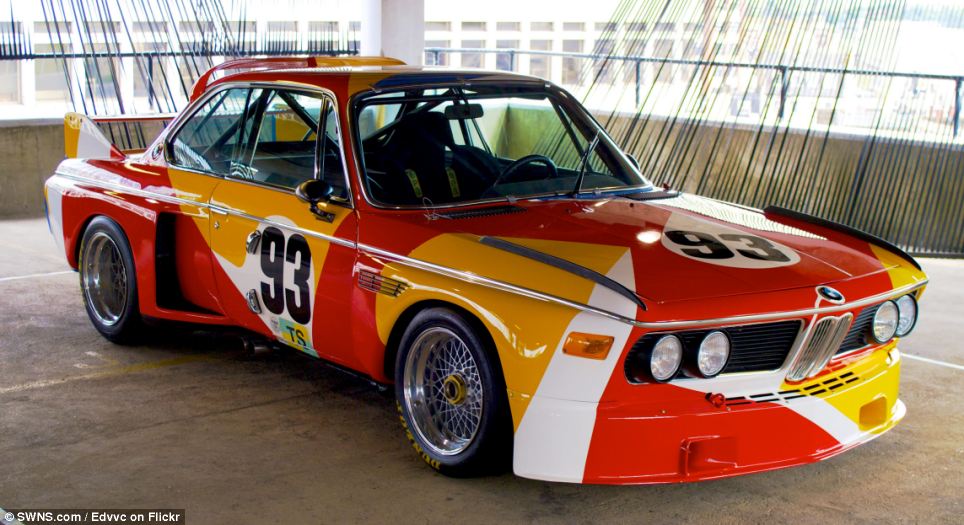
The legendary
artist took a mere 23 minutes to cover the Group 4 racing car, which went on to
race at the 24 hours of Le Mans endurance race in 1979, finishing second in its
class and sixth overall.
BMW is unlikely to
part company with the Warhol, despite the pop artist's touch making it one of
the world's most valuable cars.
Warhol, whose works
fetch upwards of £40 million at auction, described his inspiration for the
design by saying: 'I tried to portray speed pictorially. If a car is moving
really quickly, all the lines and colors are blurred.'
BMW has
commissioned 17 art cars since 1975, when French racing driver and auctioneer
Herve Poulain persuaded his friend Alexander Calder to come up with a design
for a BMW 3.0 CSL ahead of competing at Le Mans.
The result of the
original art car is also on show in the unusual makeshift gallery alongside
works by Robert Rauschenberg, Jeff Koons, Frank Stella, Ernst Fuchs, M.J.
Nelson, Ken Done, Matazo Kayama, César Manrique, A.R. Penck, Esther Mahlangu,
Sandro Chia and Jenny Holzer.


Pop art: Swiss photographer captures the fleeting moment when multi-coloured soap bubbles wobble into life - then burst
Photographer Fabian Oefner
captures mysterious objects that look like visions captured by the Hubble space
telescope - but they're in fact ordinary soap bubbles, wobbling into life for a
precious few seconds before they pop.
Oefneer had to use a special
lighting rig to give his images their peacock-like colours, 'With this series
of images, I was trying to capture the beauty of these short-lived sculptures,
which consist of 99% air and actually do not have any colour at all.'
Photographer Fabian Oefner
captures mysterious objects that look like visions from the Hubble space
telescope - but they're in fact ordinary soap bubbles. Oefner explaisn 'Most of
us remember playing with soap bubbles in our childhood, when we were fascinated
by the colours of them and therefore even more disappointed when the bubble all
of a sudden disappeared again.'
Fabian, a 28-year old art
photographer from Zurich, was inspired by memories of blowing bubbles as a
child, but put scientific principles into place to get the required results.
He explains: ‘Most of us
remember playing with soap bubbles in our childhood, when we were fascinated by
the colours of them and therefore even more disappointed when the bubble all of
a sudden disappeared again.
‘With this series of images, I
was trying to capture the beauty of these short-lived sculptures, which consist
of 99% air and actually do not have any colour at all.’
But in the series he calls
'Iridient' the challenge was in lighting the subjects to make them visible to
the camera and then capturing the split second before they popped.
Fabian explains: ‘There are two
major challenges, when taking images of bursting soap bubbles. One is how to
light the bubble, so that its colours become visible and second is obviously to
capture the right moment.
‘A soap bubble is made of a
thin film of water, on which soap molecules gather on both sides. The vibrant
colours, that bubbles are famous for, are created by the reflected light
hitting the surface of the bubble. This effect is called iridescence, a
phenomenon that is also visible on the wings of the morpho butterfly or on the
tail feathers of a peacock.


Subscribe to:
Posts (Atom)