Glorious Techniculture
Tate Modern's Richard Hamilton show captures the father of British Pop Art in all his splendor
Paul Levy
EVEN IF YOU'VE never heard of Richard Hamilton (1922-2011), you probably remember several of his images—such as that of Mick Jagger and art dealer Robert Fraser handcuffed together in a police car ("Swingeing London 67") or the muscleman holding the phallic lollipop in a room loaded with American consumer goods ("Just what is it that makes today's homes so different, so appealing?" from 1956).
Hamilton was called "the father of British Pop Art," with some justification, as he transcended the usual category divisions of artistic practice, incorporating popular imagery, making installations, using Polaroid photography and, near the end of his long life, becoming a digital wizard.
Tate Modern's enormous retrospective comes close to doing justice to this polymath innovator who worked with Marcel Duchamp to reconstruct his "Large Glass," taught Brian Ferry and others from Roxy Music, adored well-designed objects such as the 1967 Braun toaster, and later made deeply political works concerning the Kent State shootings, the IRA "dirty protests" and passionate depictions of Margaret Thatcher and Tony Blair.
The only aspects a little slighted by this wonderful show are Hamilton's interest in food (he pretty much discovered Ferran Adrià when the chef ran a beach cafe near the artist's Spanish house) and the fact that he was an elegant, fluent writer of English prose.
Curators Mark Godfrey and Hannah Dewar have reconstructed Hamilton's very first installation, "Growth and Form" (1951), and the exciting 1956 "This is Tomorrow," with its working jukebox, movie-poster and art-historical motifs. Another pair of his installations has been remade at the Institute of Contemporary Arts to coincide with this show.
The room detailing his association with Duchamp shows Hamilton's remarkable mastery of the craft and engineering aspects of creating art. They became friends in the '60s, when a Duchamp retrospective was planned, and Hamilton, knowing that Duchamp's most important work, "The Large Glass" (1915-23), was too fragile to travel, devoted himself to remaking it so carefully that Duchamp signed the piece. Most fans of Duchamp (and most curators) interest themselves in Duchamp's ready-mades, the urinals and bottle racks. By doing this instead, Hamilton showed his sympathy and understanding of the hard core of Duchamp's artistry.
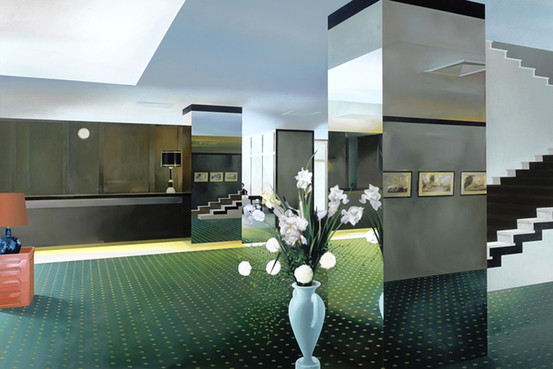
'Lobby' 1985-87 The estate of Richard Hamilton
For Hamilton, too, as this exhibition repeatedly demonstrates, making art was also an intellectual process, and he was a serious, even visionary thinker. (I should disclose that we were friends.) This fine show, planned before the artist's death, can only consolidate his high stature.
Art for the Pop of It: Artists Re-create, Subvert American Pop Culture
Art for the Pop of It: Artists Re-create, Subvert American Pop Culture: John Thomason To reference an idiom often attributed to Sigmund Freud, sometimes a hot dog is just a hot dog. Other times, it’s much mo...
Artists Re-create, Subvert American Pop Culture
John Thomason
To reference an idiom often
attributed to Sigmund Freud, sometimes a hot dog is just a hot dog. Other
times, it’s much more, as in the two fine-art hot dogs displayed (one of them
under glass) in the Boca Museum of Art’s rollicking new show “Pop Culture:
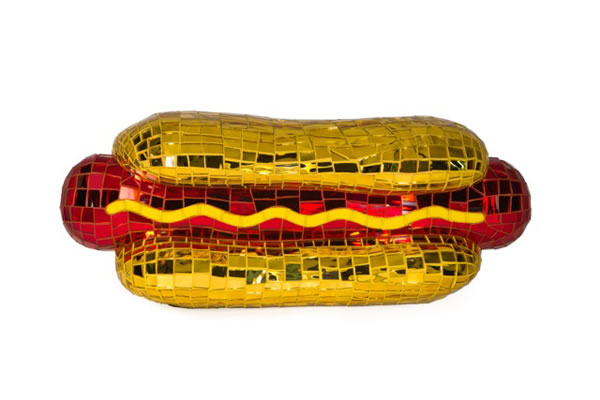
Selections From the Frederick R. Weisman Art Foundation.” Jean Wells’ “Hot Dog”
mosaic is made from shards of cut glass, the colors of gold and ruby, fashioned
into a frankfurter fit for a queen. Betty Spindler’s “Pink Hot Dog” is no less
haute, a foodstuff of questionable edibility elevated to a ludicrously
ornamental ceramic artifact.
These artists intend to draw
attention to the objects that drive our shallow consumerist economy, satirizing
them through an ironic sort of glorification: If it’s what people want, we’ll
rub their faces in it. One person’s chintzy diet is another artist’s pointed
subject matter.
This was always a rebellious
undercurrent of the Pop Art movement, which thrived in the 1960s, in part, as a
reaction to the perceived pretentions of abstract expressionism. Rather than
conceal their messages in frenetic splatters of paint or monochromatic slates,
Pop artists made the act of representation their very subject—a comic book panel
or a Campbell’s Soup can, freed from their original marketplace shackles and
exalted as museum-quality art. Modifications to these objects needn’t
necessarily be made: The pieces made their points about American values simply
by existing.
Some of these artists’ names
and their key works have become just as ubiquitous as their subject matter, and
many of them—Warhol, Lichtenstein, Rosenquist and Haring—are duly represented
in “Pop Culture,” a comprehensive and personally curated survey of Pop Art from
its American genesis through to the present day, where it has become a global
phenomenon. And while it’s always great to see these familiar masters on museum
walls, I was most taken with the artists still carrying the Pop torch decades
after its fashionability declined.
Some, like Greg Miller and his
“7-Up” collage, seem like direct descendants of the original Pop Artists,
creating work that hearkens less to 2014 than to 1964. But others seem more
forthright in their subversion: Andrew Lewicki’s “Oreo Manhole Cover,”
positioned on the floor, playfully points out the aesthetic similarities
between the sandwich cookie design and street manhole covers, while subtly
suggesting that the unhealthy snacks belong in our sewage system, not our
bellies. Likewise, Blake Boyd’s “Super Girl 2” reinterprets the image of the
buxom comic-book superhero for a post-feminist America. And speaking of gender,
wait until you see how the artist LA II reflects on biker machismo with his
fluorescent, hot-pink motorcycle.
In other places, American pop
culture invades the art of other nations, mirroring the rise of globalization.
In Dong-hyun Son’s “Two Birds,” Daffy Duck appears on what looks to be an
ancient Korean scroll, and in a pair of superb works by Masami Teraoka—one a
silkscreen, the other a watercolor—McDonalds and Baskin Robbins infects the
muted beauty of traditional Asian art, a pair of chopsticks sitting
ridiculously next to a cheeseburger.
Elsewhere, we get biting
commentary on such subjects as corporate uniformity—Michael Speaker’s stunning
wood sculpture “Team Xerox” depicts a man sticking his head in a copy machine,
with identical wooden heads resting on its trays—and the ultimate Pop
distraction, television: The robotic concoction in Nam June Paik’s “Michelin
Man Laser Robot” is festooned with a handful of TV screens, which are
transfixing despite the fact that they’re only broadcasting the same abstract
transmission. Yet we can’t stop looking.
But look onward. This is the
kind of exhibition that rewards the sustained gaze, and sometimes double takes
are required. Some of the best pieces in “Pop Culture” trick the eye,
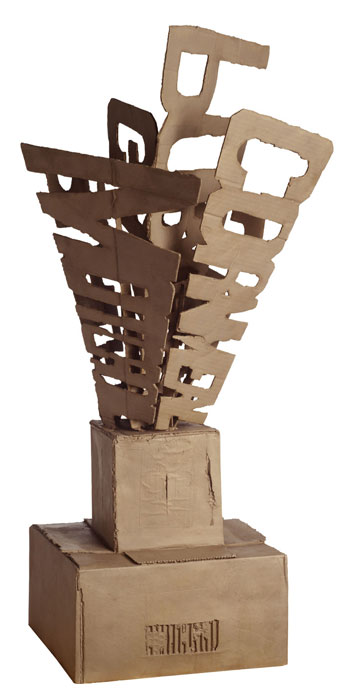
suggesting one thing while actually being another. Wayne White’s “Cornmeal
Sweat Gasoline Pork Grease Burlap Motor Oil” (pictured above) is a bronze “word
sculpture” that looks remarkably like a cardboard construction, a pair of brown
packing boxes from which the titular words spring from the top, as in a pop-up
book. Keung Szeto’s “Art Work” painting simulates a corkboard so vividly you’ll
want to try and remove one of its thumbtacks. And Richard Sigmund’s “Stop” uses
splattered acrylic to create a large-scale replica of a concrete street.
An exhibition like this can
seem overwhelming; it takes up three rooms in the museum and covers so much
territory and so many artists that it can feel like several exhibitions crammed
into one—a testament to the eclectic nature of Weisman’s collection.
Luckily, the Boca Museum’s
curatorial team did a bang-up job of presenting these works with thematic
cohesion. Roughly speaking, urban visions give way to comic book revisionism,
words and language, food, sexuality, the human anatomy, and finally fashion. If
that’s not all of human experience, it’s certainly a good chunk of it contained
in one sprawling show.
I’d like to close by going back
to the food art, because it’s the most impactful portion of the show. The
modern-day apotheosis of Pop Art may be Pamela Michelle Johnson’s “American
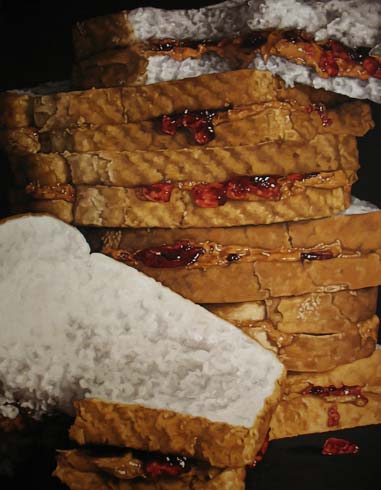
Still Life” series of giant paintings of piles upon piles of junk food. Three
of them—Pop-Tarts, Hostess cupcakes and peanut butter and jelly sandwiches—are
presented here, and under Johnson’s brush, this in-your-face comfort food looks
utterly disgusting. If nothing else, this exhibition will surely make you
rethink a Twinkie for an apple next time you’re in Publix.
"Pop Culture" is at
the Boca Museum of Art, 501 Plaza Real, through April 23. Tickets cost $6 to
$14. For information, call 561/392-2500 or visit bocamuseum.org.
Richard Hamilton: The prophet of Pop Art
On the eve of a major career
retrospective at Tate Modern, Richard
Cork recalls his meetings with the visionary artist
Richard Cork
Pop Art didn’t exist when
Richard Hamilton helped to organise the epoch-making London exhibition This Is
Tomorrow, held at the Whitechapel Art Gallery in 1956. But his section of the
show was daring enough to celebrate images culled from advertising, comic books
and film publicity. It outraged conservative English opinion at the time, and
Hamilton also made a brilliantly witty, provocative collage called Just what is
it that makes today’s homes so different, so appealing?
Here, in a room containing a
blown-up cover of Young Romance and an immense tin of ham on the coffee-table,
a muscle-bound Mr Universe flaunts his physique and clasps a shamelessly
phallic tennis racket. It thrusts out of his groin like a giant lollipop, and
the words “Tootsie POP” are splashed across its orange wrapping paper.
Looking at this collage now, we
immediately link Hamilton with the brash images produced in New York by Roy
Lichtenstein and Andy Warhol. But they did not begin their Pop work until the
1960s. Hamilton was a prophet, and his innovative collage now looks like a
clarion call for the army of Pop artists who would take the Sixties by storm.
His prodigious career is about to be celebrated in a major retrospective show at
Tate Modern, which opens this week. But back in 1956 he was struggling to make
a living. I was lucky enough to interview Hamilton on several occasions and
once asked him how he had felt then, as a 34-year-old artist in London. “I felt
completely out on a limb”, he told me. “I thought that I was being tremendously
adventurous and alone, going out into the sea with absolutely nothing in front
of me.”
At this difficult stage in his career,
Hamilton benefited from belonging to the Independent Group, a “small, cohesive,
quarrelsome, abrasive” assembly of angry young artists, critics and theorists
who met regularly at the ICA in London. He felt stimulated by the intense,
questioning attitude which gave these meetings their extraordinary vitality.
For Hamilton had always been a rebel, right back to his time studying at the
Royal Academy Schools. His experiences there ended in an explosive rumpus, and
he relished telling me about it many years later.
Hamilton first entered the RA
Schools in 1938, when he was only 16. At first the precocious teenager did
well, but the Schools were closed during the Second World War. Hamilton
recalled that “I had to go to the Labour Exchange, and they said: ‘What have
you been doing? Can you use a pencil? We’ll make you an engineering draughtsman.’”
So Hamilton received training and worked for a few dull years in an armaments
factory. When the war ended, he returned with immense relief to the RA Schools.
But the reactionary teachers hated Hamilton’s fascination with Modernism.
“Alfred Munnings had become the
President, and he used to appear after riding in Rotten Row”, Hamilton told me.
“Dressed in a rakish hat and boots, with a riding crop in his hand, he would
shout: ‘Are you one of those bastards who talks about Picasso?’ Munnings was
frightening, and my teacher Thomas Monnington also got angry when he saw my
Cézanne-influenced life drawings. He said: ‘Augustus John knocks spots off
Cézanne!’ I roared with laughter – it was hysterically funny. But Monnington
was not amused.”
Hamilton refused to change his
ideas about art. “By that time I wasn’t a kid any more, and this was all a bit
silly. Sir Walter Russell, the Keeper of the RA Schools, was still kind to me,
but he called me in and said: ‘The President has been told that you are not
profiting from your studentship. Therefore it is terminated.’ I was expelled.”
At the age of 24, the would-be artist now found himself “dragged screaming into
the bloody Army for a year-and-a-half’s national service with the Royal
Engineers”.
Hence Hamilton’s eagerness to
be defiantly innovative when he resumed his own creative work in the 1950s. But
even after the exposure afforded him by This Is Tomorrow, he “tried for eight
years to persuade dealers around London to give me an opportunity to show.” Then,
quite suddenly, he said, “I learned about the existence of Peter Blake, Allen
Jones and David Hockney”. They were still students at the Royal College of Art,
but Pop Art now created enough excitement to earn them a show in London. Even
though Hamilton was over a decade older than most of them, he felt “very
pleased that I was invited to contribute” to this exhibition. “I was carried
along on David Hockney’s golden coat-tails. He wafted in, and I was somehow
given a little reflected shine from this gold suit that he wore on special
occasions.”
During the 1960s, Hamilton
revealed just how impressive and experimental he really was. References to the
cinema abound in his work from this period, but its tone ranges from the
brashly satirical to the profoundly mournful. The leader of the Labour Party is
transformed into a bug-eyed maniac in Portrait of Hugh Gaitskell as a Famous
Monster of Filmland. But in the same year, 1964, Hamilton explored his
preoccupation with death by producing the sinister Interior II, based on a
murderous moment in the 1949 thriller Shockproof. Then, a few years later, he
seized on a press photograph of a contemporary event: Mick Jagger’s notorious
arrest on a drugs charge alongside the art dealer Robert Fraser. Handcuffed
together in a police van, the two men raise their hands in an ambiguous gesture
– half demonstrating their plight, half shielding themselves from intrusive
cameras. And Hamilton chose a typically sardonic title for his picture:
Swingeing London 67.
As he grew older, harrowing
themes dominated his work. The tragedy of Northern Ireland haunted him,
especially when he saw a TV news film of the so-called Dirty Protest at The
Maze prison near Belfast. In The Citizen, he showed the Christ-like figure of a
bearded protester who wore blankets and smeared the walls of his cell with
excrement. Hamilton was also profoundly moved by the fatal shooting of four
students by National Guardsmen at Kent State University, Ohio, during a campus
demo in 1970. “It’s a demonstration of the stupidity of mankind”, Hamilton told
me in 2010, his voice still expressing the deep emotion which had led him to
make such a powerful work from the event.
By then he was approaching 90,
but still completely dedicated to producing art at the Oxfordshire farmhouse
where he lived with his wife and fellow-artist Rita Donagh. “I have a very fine
lamp hanging over my easel”, he said. “Rita gets fed up with me if I’m not
ready for my gin and tonic by half-eight or nine. But it’s necessary to work a
lot, in spite of the pain from my arthritis. I’m getting on, and I don’t
recommend it!” He died in September 2011, and only now will the Tate Modern
exhibition, along with related shows at the ICA and the Alan Cristea Gallery,
reveal the full extent of his multi-faceted achievements.
Tate Modern’s Richard Hamilton
retrospective runs from Thursday to 26 May
Pop artist who was famous long before the Beatles
THINK of Pop Art and you will probably call to mind Andy Warhol’s Campbell’s soup tins, writes Lesley Potter. But the movement — which celebrated the explosion of newfound freedom and commercialism of the Sixties — included a great number of artists.
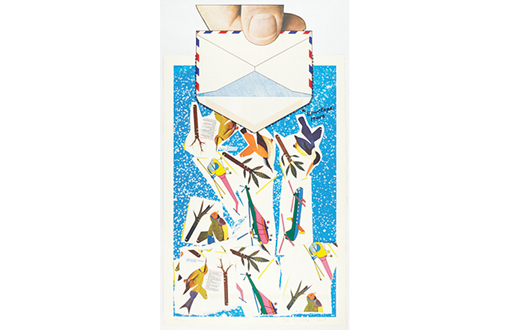
One of the British contingent, dubbed the “forgotten king of British Pop Art” is Joe Tilson, and an exhibition of his work is opening at the Bohun Gallery in Henley this weekend.
Tilson was in fact one of the founding figures of the genre in the early Sixties and he was famous long before the Beatles and David Hockney.
Born in 1928, he served in the Royal Air Force and afterwards studied at St Martin’s School of Art and then at the Royal College of Art. He had barely finished his studies before being awarded the much-coveted Rome Prize, which took him to live in Italy where the octogenarian continues to live and work today. He is a Royal Academician and his artistic career was celebrated at the Royal Academy in a retrospective exhibition in 2002.
A lifelong dedicated printmaker, Tilson has gained a reputation as one of Britain’s foremost artists producing prints, multiples, constructions, paintings and reliefs. Many of his prints are largely hand-painted and his “paintings” are based on print-making techniques.
His early work embraced the hedonism and optimism of the Sixties. In the Seventies, after his move to Italy, his work began to reflect on the five elements and Greek and Roman mythology. Italy remains a strong focus in his work and some of his most recent imagery is inspired by the churches of Venice.
All periods of the artist’s career will be represented in this solo show at Bohun Gallery, with a wide selection of prints, multiples and constructions. The show opens tomorrow (Saturday) and runs until
Proselytizer of Pop
"Ileana
Sonnabend" (1973) by Andy Warhol Andy Warhol Foundation for the Visual
Arts / ARS
By Hilarie M. Sheets
In November, a 1963 canvas from Andy Warhol's "Death
and Disaster" series sold for $105.4 million at Sotheby's, setting a new
auction record for the artist. Works from this same series were shown in
Warhol's first solo exhibition in Europe, at Paris's Galerie Ileana Sonnabend
in 1964. Not a single canvas sold then. Ileana Sonnabend had moved to Paris
from New York in 1961 and opened her gallery the following year with the intent
to introduce U.S. Pop artists to Europeans, just as she and her former husband,
Leo Castelli, had first presented Jasper Johns and Robert Rauschenberg to New
Yorkers in the living room of their Upper East Side townhouse beginning in
1957. While Sonnabend worried she would have to close the gallery after her
Warhol show, just one year later Rauschenberg won the grand prize at the Venice
Biennale, in no small part due to the success of Sonnabend's efforts to put him
and other U.S. artists on the European map.
No one at that time could have imagined the globalized
art world of today, where art has become a commodity that can command
astronomical figures and artists are promoted by dealers world-wide at art
fairs and in galleries operating in multiple cities ( Larry Gagosian leads the
pack with 13 galleries in eight cities). Now it's hard not to look back a bit
wistfully to this seminal moment, when Warhol was an unsellable artist whom
Sonnabend insisted Castelli show in New York (the exes remained remarkably
collegial and collaborative for the rest of their lives). Sonnabend opened her
second gallery in New York in 1970 and then introduced Italian Arte Povera,
Minimalist and Conceptual artists simultaneously on both continents. In the
artists she championed and her transatlantic way of working, she anticipated
much of today's art world.
"Ileana Sonnabend: Ambassador for the New," at
the Museum of Modern Art now through April 21, celebrates her pioneering role
in contemporary art through the works of some 30 artists she showed and
collected personally, including Roy Lichtenstein and James Rosenquist, whom she
also gave their first solo European shows, and Mario Merz and Jannis Kounellis,
who had their U.S. debuts with her in New York.
"There was a way in which she operated from the gut
that was astonishingly on target," says Ann Temkin, chief curator of
painting and sculpture at MoMA, who organized the show. "So many dealers,
and for that matter curators and collectors, bring their own expectations to
art. But Sonnabend was looking for . . . what didn't feel familiar, maybe what
didn't even feel good but that said to her 'this matters.'"
The show is built around the gift by Sonnabend's family
to the museum of Rauschenberg's "Canyon," a 1959 "combine"
painting in which he incorporated found objects, including a stuffed bald
eagle. When Sonnabend died in 2007, at 92 years old, her collection, of works
bought from her artists early in their careers, was appraised at close to $900
million. Much of it was sold to satisfy a $471 million estate-tax bill.
"Canyon" itself was valued at $65 million. But the stuffed bald eagle
is a federally protected animal, making the Rauschenberg illegal to sell. So
the family found itself saddled with a $40.4 million estate-tax liability on a
work with zero market value. Last year, the government agreed to drop its claim
against the estate if the family donated "Canyon" to a museum.
Born in Bucharest, Sonnabend was the daughter of a
"robber baron," as family members recall, and grew up extremely
wealthy. While she shunned ostentation as an adult, her financial independence
allowed her to act as a free agent and perhaps more of a risk-taker.
Another advantage aiding her efforts to present U.S. Pop
art to European audiences was Sonnabend's uncommon fluency with both the Old
World and New. Keen to get out of Romania after marrying, she and Castelli
moved to Paris in 1935, where they were friendly with the Surrealists. After
the Nazi occupation, the Jewish couple had a year-long flight with their
daughter, Nina, through southern France, Algeria, Morocco, Spain and Cuba
before arriving in New York in 1941. Sonnabend returned to Paris in the early
1960s with a distinctly American attitude and coterie of artists, including
Johns, Rauschenberg, Rosenquist, Jim Dine and Claes Oldenburg. Writing to
Castelli after the opening of Lichtenstein's first show in Paris in 1963,
Sonnabend clearly reveled in her convention-breaking: "There is an
accumulative effect which by now has made a deep stir in the art world. The
most invraisemblable conservative critics have come in to shake their canes at
us. We're in for a marvelous massacre!"
The reception of Pop art in Europe was mixed in the best
sense, according to Ms. Temkin. "The people who were offended were the
people you would want to be offended and the people who were inspired and
excited are the people who we care about today," she says. "From the
reports of Europeans who were there for the shows she did, they were
flabbergasted not only by the art she was showing but by her American marketing
instincts." Her tactics included putting up posters all over the city
publicizing her shows and opening her door to anyone, regardless of whether
they'd be customers.
"American Pop art completely changed the picture in
Europe," says Antonio Homem, director of the Sonnabend Gallery, located in
Chelsea since 2000, who started working in the Paris gallery in 1968 and was
adopted by Ileana and her second husband, Michael Sonnabend, in the late 1980s.
"In the U.S., it was much slower. Pop art uses things that many Americans
considered banal and discardable, while those things had a certain exoticism
about them to a European public." Mr. Homem remembers Castelli once being
questioned on a panel about why so much U.S. Pop art was in European
collections and museums. "Castelli said, 'Well, you know, they wanted to
buy it,'" a laughing Mr. Homem says.
The real watershed moment for Pop art in Europe was
Rauschenberg winning the grand prize at the 1964 Venice Biennale—a first for an
American. Sonnabend and Castelli were viewed askance by some Europeans for
their efforts in heavily promoting him for the prize. After that, the market
for Pop art took off. "In 1968 so many people told me how upset they were
that they hadn't bought Warhol or Johns or Rauschenberg and now it was too late
because they were so expensive," Mr. Homem says. "Of course buying
those artists in 1968 was a very good idea."
What may have been seen as improper then is taken for
granted today, as dealers push their artists forward for opportunities as a
matter of course. "It was really the infancy of the way the gallery world
works now," Ms. Temkin says. "The art world in Paris was this very
discreet insider's world." But Sonnabend shook it all up. "Her whole
goal," says Ms. Temkin, "was to make art accessible and known in a
widespread sense."
Ms. Sheets is a contributing editor to ARTnews magazine.
Subscribe to:
Posts (Atom)